
Could Cannabis Be Carnival’s Next Legal Goldmine?
Carnival in Trinidad & Tobago has never just been a party. It is an economy.
From mas bands and DJs to hotels, airlines, bartenders and street vendors, Carnival season injects hundreds of millions into the country. Government and industry estimates have placed Carnival-related visitor expenditure in the region of US$388 million in 2019, rising to over US$458 million in 2020 before the pandemic pause. Those figures alone demonstrate what we already know instinctively: Carnival is serious business.
So here’s the provocative question — if Carnival openly monetises sex appeal, indulgence and pleasure, why is Cannabis still treated as taboo?
And more importantly: how much money could Cannabis generate if it were fully legalised and regulated during Carnival season?
Carnival Already Sells Adult Experiences
Let’s be honest about Carnival.
It is freedom. It is skin. It is rum. It is release.
Marketing campaigns lean heavily into sensuality because sex sells — and it works. Bands sell thousands of costumes at premium prices. VIP sections sell out. Branded after-parties are oversubscribed.
If adult pleasure is already a commercial pillar of Carnival, then the resistance to legal Cannabis is less about morality and more about outdated policy.
Across the world, legal Cannabis markets have demonstrated that when governments regulate and tax rather than criminalise, they unlock new revenue streams while reducing illegal trade. The global legal Cannabis market is projected to reach tens of billions of US dollars annually within the next few years.
The demand already exists. The question is whether Trinidad & Tobago wants to capture it.
The Numbers: What Could Carnival Cannabis Earn?
Let’s keep this grounded in reality.
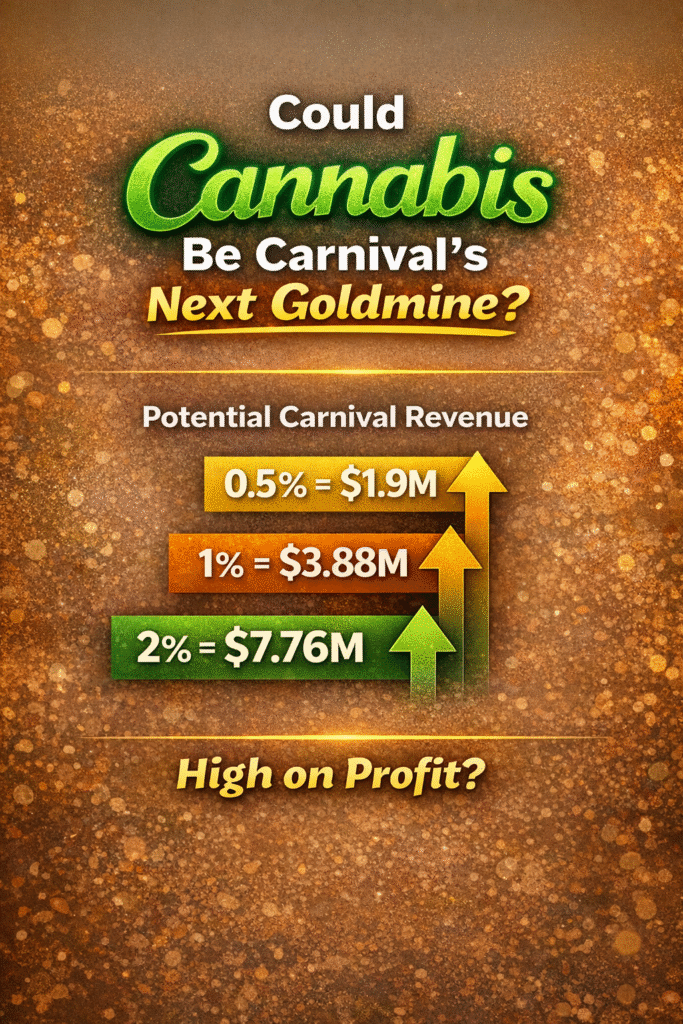
Using the publicly cited Carnival visitor expenditure of US$388 million (2019) as a baseline, we can model conservative revenue scenarios.
If legal Cannabis captured:
- 0.25% of visitor spend → US$970,000
- 0.5% of visitor spend → US$1.94 million
- 1% of visitor spend → US$3.88 million
- 2% of visitor spend → US$7.76 million
And that’s just from tourists.
This does not account for:
- Local adult consumers
- Festival pop-up dispensaries
- Branded Cannabis lounges
- Wellness and recovery products
- Carnival-themed edibles
- Licensed merchandising
Even at the most conservative estimate, Cannabis could inject close to one million US dollars directly into Carnival commerce from visitors alone. At moderate uptake, that climbs into the multi-million-dollar range.
For a country seeking economic diversification beyond oil and gas, that’s not trivial.
Beyond Sales: The Multiplier Effect
The direct revenue is only one layer.
Legalisation opens doors for:
- Licensed micro-growers
- Edible manufacturers
- Testing laboratories
- Retail staff
- Brand ambassadors
- Tourism experiences
Imagine:
- “Recovery tents” offering CBD muscle rubs after the road
- Low-dose edible tasting events for international visitors
- Cannabis-friendly wellness retreats packaged around Carnival week
- Regulated branded pop-ups inside major band camps
This is job creation. This is small business expansion. This is taxable commerce.
If Sex Toys Can Be in Goodie Bags…
Carnival already integrates adult products into its ecosystem.
Major bands have distributed thousands of sex toys to female masqueraders as part of their brand activations. That decision wasn’t scandalous — it was savvy marketing. It embraced adult freedom as part of the Carnival ethos.
If that’s acceptable, then regulated Cannabis products — responsibly packaged, labelled and age-restricted — could also be included in goodie bags or VIP experiences.
Consider:
- CBD recovery balms for sore muscles
- Pre-roll vouchers redeemable at licensed dispensaries
- Micro-dose edible samples with clear dosage guidance
The benefits are practical before and after the road: relaxation, muscle recovery, sleep support.
The concept is the same.
Pleasure is marketable.
Cannabis could sell Carnival — not necessarily to the same extent as sex appeal, but through the same commercial logic.
Addressing the Taboo
The stigma around Cannabis in Trinidad & Tobago is largely historical.
But attitudes are shifting across the Caribbean and globally. Jurisdictions that regulate Cannabis rather than criminalise it have seen:
- Reduced illegal market activity
- Increased tax revenue
- Better product safety standards
- Improved consumer education
Legalisation is not about encouraging reckless use. It is about control, taxation and safety.
If Carnival can manage alcohol sales through licensing, security and vendor control, it can manage Cannabis the same way.
Safety First: Regulation Is Key
For this to work, it must be structured.
A legal Carnival Cannabis framework would require:
- Strict age verification
- Clear labelling and dosage guidance
- Designated consumption zones
- Public education on mixing Cannabis with alcohol and heat
- Quality testing and safety standards
Responsible regulation reduces harm. Criminalisation does not eliminate demand — it simply drives it underground.
The Tourism Advantage
Trinidad Carnival is a global brand.
International visitors travel specifically for the experience. In destinations where Cannabis is legal, “Cannabis tourism” is a recognised niche.
Even if only a small percentage of Carnival tourists were interested in legal Cannabis experiences, the incremental revenue would be significant.
If 10,000 visitors spent an average of US$150 on legal Cannabis products during Carnival, that alone equals US$1.5 million in direct sales.
That’s before taxation.
That’s before local consumer spending.
That’s before branded partnerships.
Economic Diversification in Plain Sight
Trinidad & Tobago has long discussed economic diversification.
Carnival is already one of the country’s most powerful non-energy revenue drivers. Integrating a regulated Cannabis market into Carnival would:
- Increase per-visitor spend
- Extend length of stay
- Create new entrepreneurial opportunities
- Generate tax revenue
- Reduce illegal market leakage
This is not about turning Carnival into a smoke-fest.
It is about recognising existing demand and regulating it intelligently.
The Bigger Cultural Shift
Carnival has always been about freedom — freedom of expression, movement, body and spirit.
Normalising adult, regulated Cannabis use fits within that ethos more naturally than many are willing to admit.
The real question is not whether Cannabis belongs at Carnival.
It is whether Trinidad & Tobago is ready to convert stigma into strategy.
If Carnival can monetise sex appeal with confidence, then Cannabis — responsibly regulated — can absolutely become part of the commercial ecosystem.
Not as a gimmick.
But as a legal, taxable, economically strategic industry.
Stay High & Stay Safe
Asha & Ayanna Wadada