How Cannabis Content Is Restricted on Social Media — and How We Keep Going
If you are a Cannabis content creator today, chances are you have felt it. Posts disappearing. Reach suddenly dropping. Content being flagged, restricted, or quietly buried without explanation. For those of us creating openly and honestly about Cannabis culture, education and advocacy, these experiences are not accidental. They are the result of how Meta governs Cannabis-related content across its platforms, including Facebook, Instagram and Threads.
At Ladies of 420, we have encountered these restrictions directly. As two women creating authentic Cannabis content, we have seen posts limited, visibility reduced, and engagement altered simply because Cannabis is part of our everyday reality and our message. Yet despite these challenges, we remain committed to telling our story, educating our community, and pushing forward until Cannabis is treated with the respect and understanding it deserves.
This blog breaks down exactly how Meta approaches Cannabis content, why enforcement feels inconsistent, how creators in Trinidad and Tobago and beyond are affected, and how we navigate these restrictions without compromising our integrity.
Meta’s Position on Cannabis Content
Meta categorises Cannabis as a “regulated good”. This classification places Cannabis alongside items that the platform considers legally sensitive across different countries and jurisdictions. Even in places where Cannabis is legal or decriminalised, Meta applies a global standard that prioritises the most restrictive legal environments.
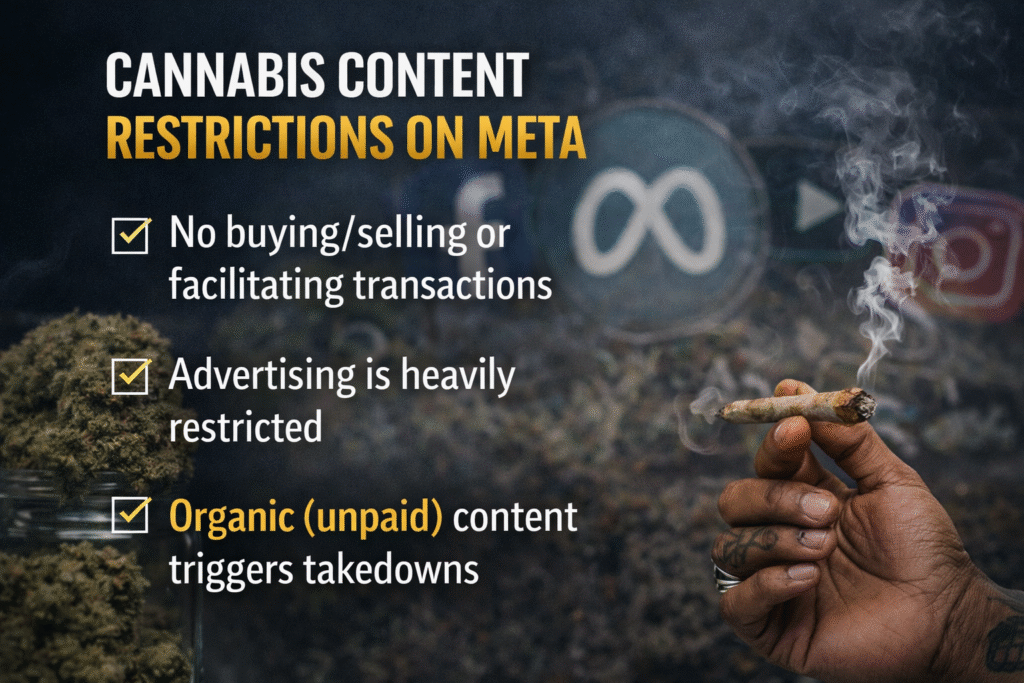
In practical terms, this means Meta prohibits content that attempts to sell, buy, trade, gift or facilitate access to Cannabis or THC-containing products. This applies to both paid advertising and organic posts. Even indirect language suggesting transactions, pricing, or private messages for access can trigger enforcement.
Advertising rules are even stricter. Meta does not allow paid advertisements for Cannabis or THC products under almost any circumstance. Limited exceptions exist for certain hemp-derived products that contain no THC and no CBD, but even those require extensive verification and approval processes.
For creators, the most confusing aspect is that educational and cultural Cannabis content is technically allowed, yet frequently penalised in practice.
Organic Content Is Not Immune
Many people assume that if they are not selling Cannabis, their content should be safe. Unfortunately, this is not always the case.
Meta’s moderation systems rely heavily on automation. Algorithms scan captions, hashtags, visuals and even comments for signals that may suggest prohibited activity. Cannabis-related keywords, imagery, or discussions can be misinterpreted as promotion, even when the intent is educational or cultural.
As a result, creators often experience:
- Reduced reach without notification
- Posts removed with vague explanations
- Accounts temporarily restricted or limited
- Content excluded from search or explore features
This is particularly challenging for Cannabis educators, advocates, and lifestyle creators who are not selling anything, but are still caught in the enforcement net.
The Reality for Cannabis Creators in Trinidad and Tobago
For creators in Trinidad and Tobago, the situation is even more nuanced. Cannabis laws locally exist within a framework of decriminalisation rather than full legalisation. While small amounts may be permitted under local law, global platforms like Meta do not tailor enforcement to regional legal subtleties.
As Caribbean Cannabis creators, our voices are already underrepresented. When content restrictions are layered on top of that, visibility becomes even harder to maintain. Educational discussions about Cannabis culture in Trinidad and Tobago, Rastafarian heritage, wellness, and community advocacy are often flagged without regard for local context.
This creates a digital environment where Caribbean Cannabis stories struggle to gain the same visibility as content from regions with louder industry voices.
Our Experience at Ladies of 420
At Ladies of 420, we have experienced the impact of Meta’s Cannabis restrictions first-hand. Posts that simply show daily life, cultural expression, or conversations around Cannabis education have been limited or removed. In some cases, older content has been flagged months after posting.
Despite this, we refuse to dilute our message. Our content is rooted in authenticity, education and lived experience. We are not promoting sales. We are not encouraging illegal behaviour. We are documenting culture, sharing knowledge, and advocating for understanding.
Being targeted by these restrictions has not silenced us. Instead, it has pushed us to become more intentional, more strategic, and more grounded in why we create.
What Content Is Generally Safer Under Meta’s Rules
While no approach is entirely risk-free, certain types of Cannabis content tend to align more closely with Meta’s guidelines when executed carefully.
Educational content is one of the strongest categories. Posts that focus on policy discussions, scientific research, historical context, or harm reduction are less likely to be interpreted as promotion. Clear educational framing in captions is essential.
Cultural and lifestyle storytelling is another viable space. Sharing experiences, traditions, and community narratives without highlighting consumption or transactions allows creators to remain visible while staying within platform boundaries.
Advocacy content also plays an important role. Discussions around decriminalisation, stigma, social justice, and public policy are permitted, provided they do not include instructions on obtaining Cannabis.
How We Navigate Meta’s Restrictions
Navigating Meta’s Cannabis rules requires intention rather than fear. At Ladies of 420, we focus on compliance without sacrificing authenticity.
We avoid transactional language entirely. There are no prices, no invitations to purchase, and no calls to action that could be interpreted as facilitating access to Cannabis.
We prioritise education and context in our captions. Every post clearly communicates why the content exists and what conversation it is meant to spark.
We also invest in platforms we own. Our website, blog and email communications allow us to connect with our audience without algorithmic interference. Social media is a tool, not the foundation.
Age awareness is another key element. Clear adult-only messaging signals responsibility and reduces the likelihood of automated restrictions.
Most importantly, we remain consistent. Consistency builds trust with our audience and reinforces that our work is about culture and education, not commerce.
Why Authenticity Still Matters
It can be tempting to water down Cannabis content to avoid restrictions altogether. However, erasing Cannabis from our narratives only reinforces stigma. Authentic voices are necessary to normalise conversation and challenge outdated perceptions.
Meta’s policies may limit reach, but they do not define truth. Culture does not disappear because an algorithm suppresses it. It simply finds new pathways.
As women creating Cannabis content from Trinidad and Tobago, we understand the responsibility that comes with visibility. We also understand the importance of persistence. Change happens because people continue to speak, even when the system resists.
The Future of Cannabis Content on Meta
There have been small shifts in how Meta handles Cannabis-related search and visibility, but the core restrictions around sales and advertising remain firmly in place. Until global Cannabis laws evolve further, platforms like Meta are likely to continue enforcing conservative standards.
That means Cannabis creators must adapt, diversify, and protect their voices. Education, storytelling and community building will continue to be the strongest tools available.
Final Thoughts
Meta’s restrictions on Cannabis content are real, frustrating and often inconsistent. But they are not the end of the conversation.
At Ladies of 420, we will continue to create, educate and advocate. We will continue to represent Cannabis culture honestly, especially from the Caribbean perspective. And we will continue pushing forward until Cannabis is treated with the openness and respect it deserves.
Our presence online is not accidental. It is intentional. And no algorithm can erase that.
Stay High & Stay Safe
Asha & Ayanna Wadada